Reproduction of the CLAIRE de novo protein-binder design pipeline
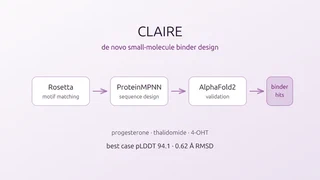
A computational project — independent work alongside my wet-lab dissertation. I reproduced the CLAIRE small-molecule binder-design pipeline end-to-end, then pushed it onto two targets it had never been run on.
Three targets, not one
| Target | Why this one |
|---|---|
| Progesterone | the repository’s built-in example — a correctness baseline |
| Thalidomide | generalization test |
| 4-Hydroxytamoxifen (4-OHT) | generalization test |
The latter two were chosen deliberately: their polar-handle configurations are chemically distinct enough to probe generalization rather than repeat a known result.
All three produced AlphaFold2-self-consistent candidates — best case pLDDT 94.1 at 0.62 Å RMSD.
Why it matters to my own work
My dissertation designs bioPROTACs, which need a binding domain against their target — so the binder is the limiting reagent, and borrowing one confines you to targets somebody has already solved. Designing binders directly is how that constraint comes off.
Related: testing the generalizability of a multistate design method on KRAS
I extracted the computational recipe of Guo et al. (Science, 2025) from the primary literature and built a three-layer framework to test whether it transfers to the Ras superfamily:
- Calibration — T35S, a known state-switching mutant: does the diagnostic detect what it claims to?
- Clinical noise — G12D, G12C: does it fire on any substitution?
- Application — the hypervariable-region mutation from my own dissertation.
The first two layers are what make the third worth believing. This also meant rebuilding the simulation system in AMBER after diagnosing that a prior model was nucleotide-free — the replacement is GppNHp- and Mg²⁺-bound, with de novo parameterization for the ligand and the farnesylated cysteine anchor.
Toolchain
Rosetta/PyRosetta · ProteinMPNN · AlphaFold2/ColabFold · GROMACS · AMBER/AmberTools · OpenMM · CHARMM-GUI · antechamber, AM1-BCC, GAFF2 · Python · Linux and cloud GPU

I am Muzi Ouyang (欧阳木子) — I go by Mia. I am a PhD candidate in Chemistry at Tsinghua University, advised by Prof. Ying Tan (谭英) at the Institute of Biopharmaceutical and Health Engineering (iBHE) in Shenzhen. I work on targeted protein degradation: designing bioPROTACs that recruit E3 ligases to destroy proteins small molecules struggle to drug — and working out why that degradation sometimes fails.
My dissertation has two halves. The first is a dual-target bioPROTAC that co-degrades ERα and PI3K p85α, re-sensitizing tamoxifen-resistant breast cancer cells to endocrine therapy. The second is a KRAS-targeting degrader, where I found a resistance mutation in the hypervariable region that lets KRAS escape a multimerization-dependent platform, and used all-atom molecular dynamics to trace the conformational mechanism behind the escape.
Alongside the wet lab I work in computational protein design — Rosetta, ProteinMPNN and AlphaFold2 — including an end-to-end reproduction of the CLAIRE de novo binder-design pipeline, published openly with its debugging narrative. My training spans animal science, basic medicine and chemistry, which is why I move between wet-lab mechanism and computational design rather than choosing between them.
I expect to defend in June 2027 and am seeking postdoctoral positions starting in late 2027. If my work overlaps with your group’s, I’d be glad to hear from you — my CV is linked above. Write to me at mumumia.1009@gmail.com, or oymzmia@163.com if you are corresponding from within China.